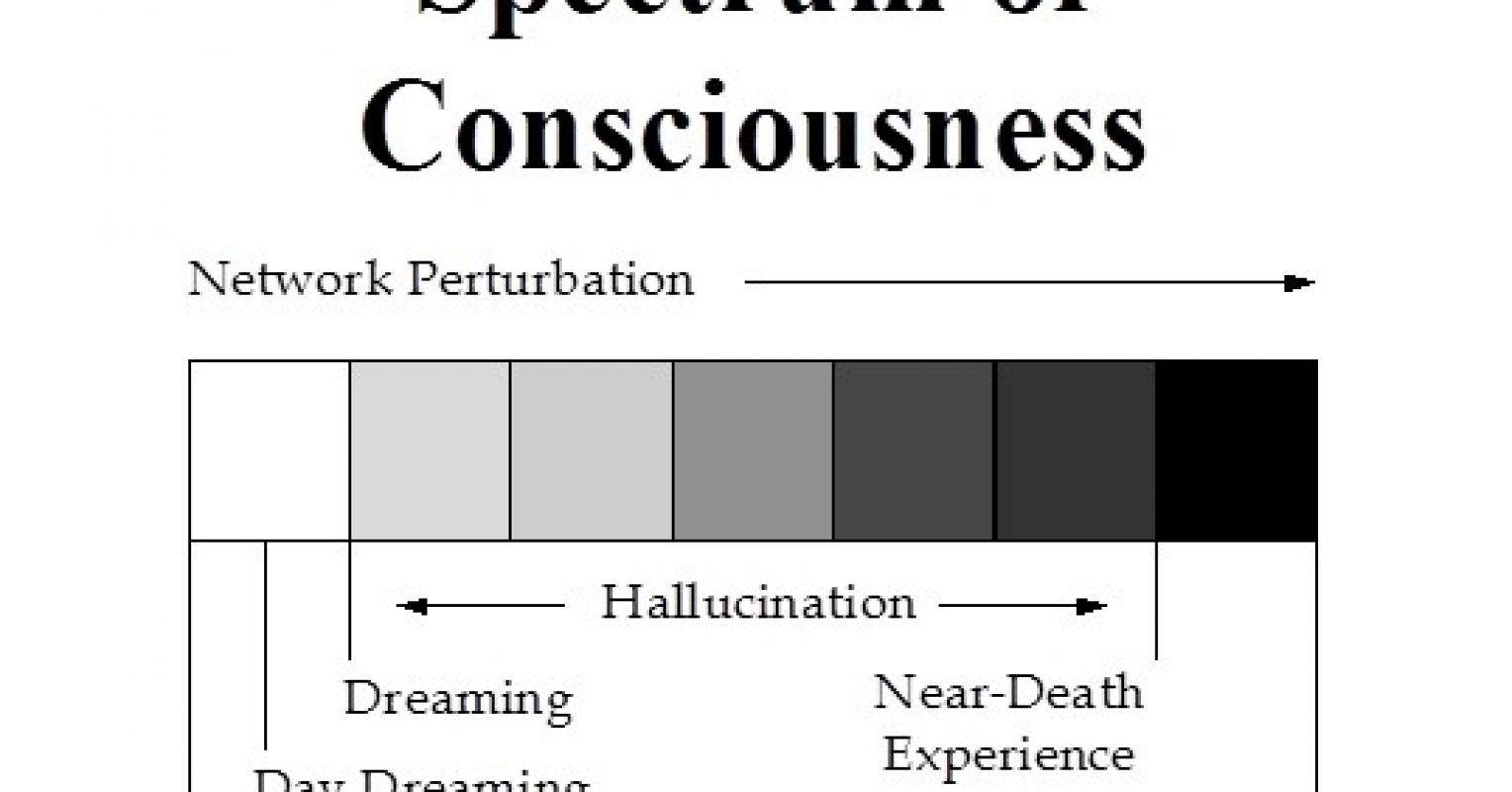
In order to study something, we first need to be able to define what it is, and a classic question in psychology has to do with the definition of consciousness. Most people think of consciousness as awareness of the world around us, drawing a sharp dividing line between consciousness (when we’re awake) and unconsciousness (when we’re asleep).
However, it appears that this sharp and clear dividing line between sleep and wakeful consciousness is not all that sharp after all.
Psychology might define consciousness as a “function of the human mind that receives and processes information” via our sensory systems and the reasoning ability of our minds. We then “store it or reject it” using our imagination, emotions, and memory (Vithoulkas and Muresanu, 2014). Neurobiologically, consciousness is defined as a “spectrum of states that range from physiological states to states of impaired consciousness.” These mental states can be modified “either by self-training (transcendental meditation) or by drug intake” (Vithoulkas and Muresanu, 2014). In the lab, these two states of consciousness (wakefulness and sleep) can be monitored and distinguished by patterns of brain activity visible in an EEG.
Wakeful consciousness is relatively easy to describe. We see, hear, touch, taste, and feel the world around us (although not perfectly), send that sensory information to our brain to be sorted and combined with other events, and if it matters to us, stored. If it doesn’t matter, it gets tossed out.
Sleep is considered not unconsciousness, but rather an altered state of consciousness. Our neural cognitive systems that usually run in the background are functioning at a reduced level and tend to produce “misrepresentations such as hallucination, delusions, and memory distortions….such generally misrepresentational, temporary and reversible states are dreaming, psychotic episodes, psychedelic drug experiences,” and the like (Revonsuo, Kallio, and Sikka, 2009).
There are two basic phases of sleep, each identifiable by changes in the EEG. The traditional model of sleep holds that we cycle through first what is known as Non-Rapid Eye Movement Sleep or NREM sleep, which has three sub-stages, N1 through N3. In each stage, we fall more deeply asleep and are harder to wake. If you awaken the sleeper during NREM sleep, they will typically tell you they were not dreaming, or at least not having the same kind of dreams we usually think of when we think of dreaming. They might tell you they had a sudden, short-lived flash of a scene that was low in intensity and emotion. REM sleep dreams are vivid, intense, have a storyline, are elaborate, and are often bizarre and emotional (Purves, Augustine, Fitzpatrick, et al., 2001).
Recent research suggests the traditional model of sleep might need updating. Decat, Le Coz, Senechal, et al. (2026) found that dream states can and do happen when we’re awake and conscious, with no sharp, clear difference between our thinking when we’re awake and when we’re asleep.
Decat and his colleagues wanted to assess consciousness during the transition period between wakefulness and actual sleep (stage N3). They recorded EEGs, and, in condition 1, asked participants to hold onto a bottle as they rested in a chair. As they relaxed, entering stages N1 and N2, their muscles relaxed, allowing the bottle to fall to the floor, awakening the participant. In condition 2, their rest was interrupted irregularly by an auditory alarm. At each “probe,” participants were asked, “What crossed your mind in the last 10 seconds before the interruption?” They then rated their thoughts on a six-point scale along four dimensions: the spontaneity, bizarreness, and fluidity of those thoughts and how “awake” they perceived themselves to be.
Using a statistical technique called Principal Component Analysis, the researchers were able to identify four distinct types of mental experiences or content during the transition between sleep and wakefulness. These four experiences were (1) fragmented content – one participant recalled a brief image of his father crossing the street, (2) alert content—the participant reported listening to the sounds in the room around him, (3) bizarre content, like seeing mini-aliens, and (4) deliberate content, like thinking about what was on the schedule for tomorrow.
Finally, using the EEG recordings of the 10 seconds just before each probe, they identified content-specific neural signatures of each type of content and whether participants were awake or in stages N1 or N2.
They found that the content of their participant’s thoughts did not seem to follow that supposed sharp boundary between wakefulness and sleep. In fact, each of the four content types occurred during wakefulness, at the beginning of sleep (N1), and during light sleep (N2). One participant reported “ants crawling on me with crossword puzzles in the background” while awake and in N1, and another reported “thinking about work” while in N2 (light sleep). Participants were as likely to have a bizarre, dream-like thought while awake as they were to have a mundane dream about everyday life when asleep.
BTW: Thomas Edison used the bottle dropping technique to wake himself from naps. He maintained that he did his best work in this transition period between wakefulness and sleep. Lots of people seem to agree with him. If you’d like to explore your own creativity, see Lacaux, Andrillon, Bastoul et al (2021) for more.
www.psychologytoday.com