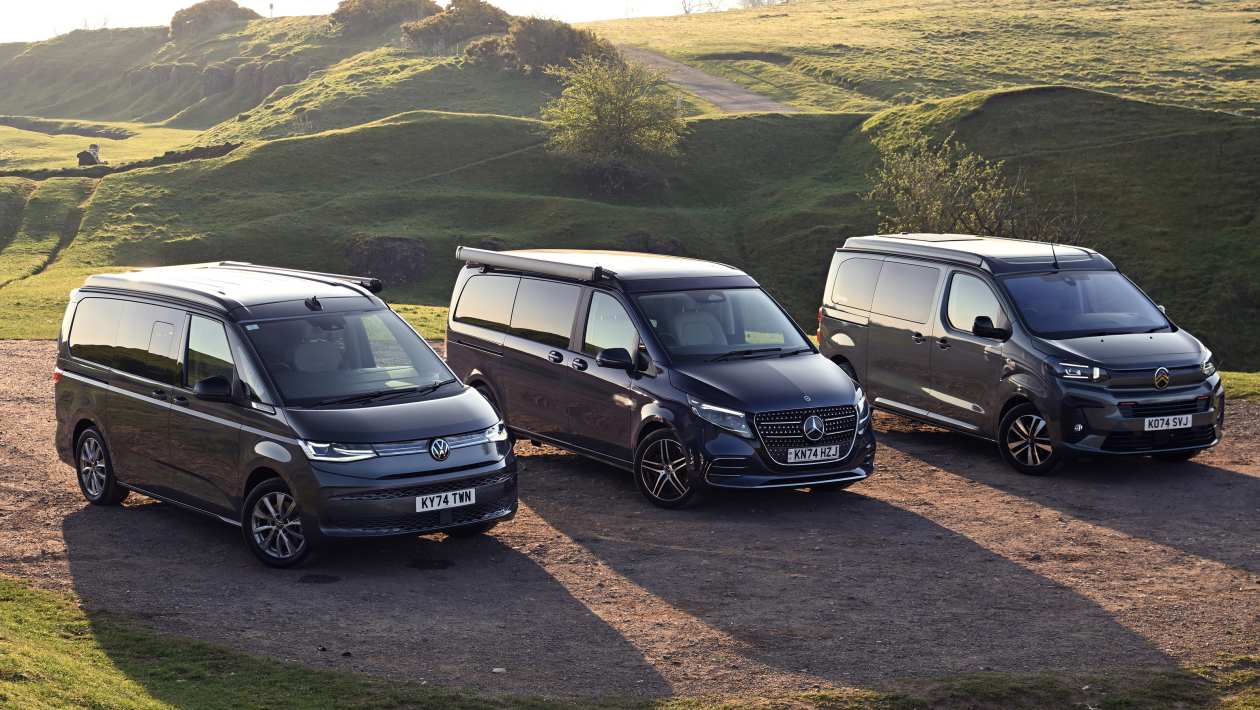
There’s no place like home, as the old saying goes. But sometimes it’s nice to have a change of scenery. You could get a hotel or sleep in a tent, but why do that when you can drive part of your home to a much nicer place and get a new outlook on the world?
That’s the answer that a humble (or not-so-humble) campervan offers: the ability to take a big part of your own life – even the family pets – on the adventure with you.
As a result, for seasoned campers, the vehicle became part of the family, with Volkswagen cornering this market for decades. Now, it’s the turn of an all-new Volkswagen California to attract the latest generation of home-from-home adventurers.
But is it the best option out there? Citroen might have an answer to that with the all-new Citroen Holidays. On paper, it looks like a bit of a bargain beside the VW, so we’re keen to find out what, if anything, it’s missing for the cash.
Finally, we have Mercedes. The firm might be best known for desirable limousines such as the S-Class, but it has sprinkled some of that luxury car magic into the camper segment, too. Here, the latest, recently revised Marco Polo takes the fight to VW and Citroen.
Volkswagen California
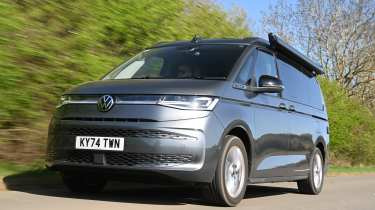
| Model: | Volkswagen California Ocean |
| Price: | £80,497 |
| Powertrain: | 2.0-litre 4cyl petrol, 201bhp |
| 0-62mph: | 10.0 seconds |
| Test efficiency: | 30.8mpg |
| Test range: | 407 miles |
| Annual VED: | £360 |
Volkswagen’s camper heritage forms a huge part of the firm’s identity, and through various iterations the formula has evolved into the latest model you see here. The range starts from £63,481 for the Beach Camper, which gets a roof-mounted bed, but lacks the extensive kitchen and living facilities that its rivals in this test feature.
Used — available now

2023 SsangYong
Tivoli
3,000 milesAutomaticPetrol1.5L
Cash £14,399
View Tivoli
2019 Volvo
V40
27,507 milesManualDiesel2.0L
Cash £11,897
View V40

2017 Renault
Koleos
67,488 milesAutomaticDiesel2.0L
Cash £11,497
View Koleos
2023 Volkswagen
ID.4
27,187 milesAutomaticElectric
Cash £18,149
View ID.4
The £70,681 Coast trim gets similar features (but less on-board tech) to the top- spec Ocean, which costs from £77,581, or £80,497 with the petrol engine tested here.
Tester’s notes
As in most of the VW’s rivals, the front seats can swivel when the van’s parked so that they face the rear of the cabin. It’s a bit fiddly to do, because you need to make sure that the backrests are angled as far forward as they go to avoid fouling against the door pillars and steering wheel as they rotate.
Also slightly more tricky to use than we’d like is the boot. While it houses the outdoor camping chairs, the downside is that their bulky housing makes fitting an electronic tailgate impossible. As a result, the manual door is very large and very heavy.
Having an electrically operated roof makes preparing for camp so much easier than a manual option, but the California’s wasn’t without its drawbacks. The system is very cautious and pauses after its first move before presenting a warning message for the user to check if it’s safe to continue.
Despite being careful, we struggled to stop the roof from snagging when closing, with the material catching in the hinges, which risked rips and tears. This was even more of a challenge if there was a slight breeze while opening or closing.
Mercedes Marco Polo
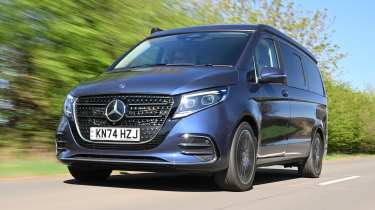
| Model: | Mercedes V 300 d Marco Polo |
| Price: | £88,455 |
| Powertrain: | 2.0-litre 4cyl diesel, 234bhp |
| 0-62mph: | 7.9 seconds |
| Test efficiency: | 34.0mpg |
| Test range: | 524 miles |
| Annual VED: | £360 |
Unsurprisingly for a vehicle with a Mercedes badge on the nose, the V-Class Marco Polo is the most expensive model here. Prices start at £88,455, making it almost £11,000 more than the fully kitted-out California diesel. That’s before you consider the modest equipment levels, too.
Mercedes buyers will need to pay another £975 for a side awning, and £590 for a camping table and a pair of chairs. As tested in Premium Plus with AMG Line Package trim, the total price is £98,515.
Tester’s notes
Among the Marco Polo’s options is a fabulous feature for campers. The air-suspension system can be equipped with a self-levelling function, which alters the ride height at each individual corner so that the vehicle remains completely level when parked – perfect when you arrive at a pitch that’s on a slight angle.
When rivals have you fiddling with wheel chocks and using your own eye for level, this makes things infinitely easier. It’s costly, at £3,100, but worth the outlay – especially given the Marco Polo’s asking price.
Our time behind the wheel (and under the covers) of the Marco Polo was in a model fitted with the AMG Line Package. Unless you’re really concerned about appearances, it’s a pack that we’d skip, because it’s only adding a range of cosmetic upgrades that you could very easily live without.
Among them are an AMG bodykit with deeper front bumpers, a new grille design, a lip spoiler and side skirts, a set of 19-inch alloy wheels, plus carbon fibre-effect trim and new floor mats; that’s £4,650 for extras without any substance.
Citroen Holidays
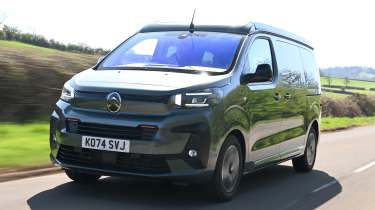
| Model: | Citroen Holidays |
| Price: | £55,395 |
| Powertrain: | 2.0-litre 4cyl diesel, 175bhp |
| 0-62mph: | 10.6 seconds |
| Test efficiency: | 30.3mpg |
| Test range: | 467 miles |
| Annual VED: | £360 |
We have to admit that when we first saw the Citroen Holidays asking price of £55,395, we did a little double take. Once we checked that the price tag was indeed correct, we then dived into the standard kit list to discover what equipment the Holidays misses out on relative to its competitors.
And while it does sacrifice just a few of the luxuries that the others in this class can provide, the French model is fundamentally still a van-based camper that sleeps four people and has its own kitchen facilities.
Tester’s notes
There are some areas where the Holidays doesn’t feel more like an aftermarket conversion than a purpose built camper, but beyond some slightly cheap-feeling kitchen units inside, the exterior detailing is one of the main giveaways.
We’re pleased that Citroen has opted to offer metallic paint free of charge across the range, but the badging looks comically cheap. The Holidays lettering looks more like it’s been hastily printed and slapped onto various body panels rather than a deliberate design choice.
Compared with the Citroen’s nearest rivals, it’s clear that the kitchen units are one area where money has been saved. The fake wood trim panels don’t quite have the tight fit of those found in a Volkswagen California, and the pop-out door-pull buttons feel a little cheaper than sturdy handles.
The fridge is not integrated as neatly, because it is hidden underneath a small removable wooden panel, while the speckled finish of the floor, although hard wearing, reminds us of the sort of thing you’d find in a school or a hospital.
Head to head
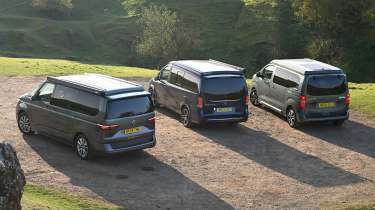
On the road
All three of these campers take up a similar amount of space on the road, but the VW feels by far the most wieldy and is the easiest to handle.
The Citroen is rather ponderous around the turns in comparison, although it does ride smoothly. The Mercedes is similarly soft over bumps, but its air suspension gives it much better body control than the Holidays. The performance of the Marco Polo’s diesel engine is excellent.
Tech highlights
There are certain features that make campers so much easier to use, and an electrically operated roof is among the best.
Both the Mercedes and VW have them – the California’s top can be operated via VW’s smartphone app which makes life much easier once you’ve arrived to set up camp. The Citroen’s manual top is a little fiddly, and closing it takes a firm heave that some people might struggle with.
Price and running
At just under £55,000, the Citroen is by far the most affordable of the three. It lacks some of the luxuries in the other two and isn’t quite as well finished, but it can still sleep four people comfortably.
The Mercedes feels the most luxurious, but there’s a very steep price to pay; tick all of the option boxes and it’ll breach £100k. The VW strikes the best balance between price and accommodation.
Practicality
All of these cars are superbly accommodating, with loads of room for four passengers and endless storage space. At the campsite, they’re a fun place to live, too.
The California has access to the rear cabin from both sides thanks to its sliding doors, but this results in a smaller kitchen; the Mercedes and Citroen each have two hobs to the VW’s one. But the California’s fridge is the largest of the three.
Accommodation
The ease of getting these camper vans into their sleeping configuration varies significantly.
The Mercedes’ back seats drop electrically at the touch of a button. The California’s operation is manual but easy to do, while the various catches and levers that lower and raise the Citroen’s seats make the process rather fiddly in comparison – plus the seats don’t lay as flat as in the other two models here.
Ownership
Volkswagen makes Cali life very reassuring thanks to a five-year package that includes free servicing, warranty and breakdown cover.
The Merc gets a three-year warranty and the brand’s industry-leading 30-year breakdown package, while the Citroen comes with a three-year warranty and 12 months of roadside assistance. But Citroen finished highest (fifth) in our Driver Power customer satisfaction survey.
Verdict
Winner: Volkswagen California
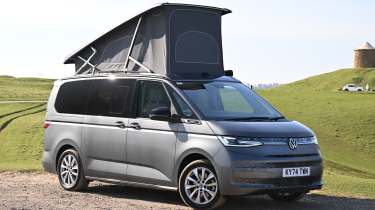
It’s clear that Volkswagen has put all of its know-how into the California, because this superb all-rounder strikes the perfect balance between luxury, technology and affordability.
The rear living area is only let down by its single hob, but is spacious and easy to convert from driving to sleeping. It’s easily the best here on the road. If you’re planning your next decade’s worth of trips away, there’s nothing that’ll do it better.
Runner-up: Citroen Holidays
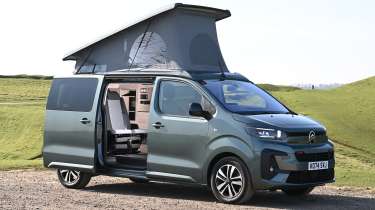
On paper, the Holidays looks like a bargain, and the price alone means the Citroen deserves a place on many camping plots at home and abroad. A punchy diesel engine, a soft ride and great visibility will make the journey there a cinch, as well.
There are compromises at this price point, though, and we’d be willing to pay a little extra for the convenience of a better-designed roof system and less fiddly lower bed. If the VW and Mercedes are beyond your budget, the Holidays is an excellent alternative.
Third: Mercedes Marco Polo
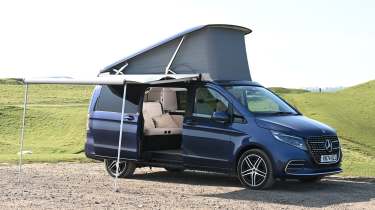
Third place in this test isn’t a reflection of how good the Marco Polo is as a camper van. In many ways it has the other two beaten; its performance, quality, finish and tech are better than in either rival.
But while it holds an advantage in some areas, that’s not enough to justify the Mercedes’ price tag. It’s hard to argue the case for nicer materials and trick suspension technology for the £45,000 you’ll need to pay beyond the Citroen Holidays, or the £35k or so that a Volkswagen California with almost all the same features can offer.
Prices and Specs
| Volkswagen California | Citroen Holidays | Mercedes V300d Marco Polo | |
| Our choice | VW California Ocean | Citroen Holidays | Mercedes V300d Marco Polo |
| Price from/price of our choice | £80,497/£84,754 | £55,395/£55,395 | £88,455/£98,515 |
| Powertrain and performance | |||
| Powertrain | 4cyl petrol/1,984cc | 4cyl diesel/1,997cc | 4cyl diesel/1,950cc |
| Power/torque | 201bhp/320Nm | 175bhp/400Nm | 234bhp/500Nm |
| Transmission | Seven-speed auto/fwd | Eight-speed auto/fwd | Nine-speed auto/rwd |
| 0-62mph/top speed | 10.0 secs/124mph | 10.6 secs/106mph | 7.9 secs/134mph |
| Fuel tank capacity | 60 litres | 70 litres | 70 litres |
| WLTP economy | 30.7mpg | 29.8mpg | 36.7mpg |
| Test efficiency/range | 30.8mpg/407 miles | 30.3mpg/467 miles | 34.0mpg/524 miles |
| CO2 emissions | 210g/km | 208g/km | 207g/km |
| Dimensions | |||
| Length/wheelbase | 5,173/3,124mm | 4,981/3,275mm | 5,140/3,200mm |
| Width/height | 1,941/1,972mm | 1,924/2,010mm | 2,249*/1,990mm |
| Boot lip height | 583mm | 563mm | 544mm |
| Kerbweight/towing weight | 2,395/2,400kg | 2,365/2,500kg | 2,551/2,500kg |
| Tow bar | £948 | £700 | £875 |
| Turning circle | 12.1 metres | 12.4 metres | 12.4 metres |
| Costs/ownership | |||
| Residual value (after 3yrs/36,000 miles) | £43,581/54.14% | £26,529/47.89% | £44,174/49.94% |
| Depreciation | £36,916 | £28,866 | £44,281 |
| Insurance group/quote/VED | £941/£360 | £776/£ 360 | £1,018/£360 |
| Service cost | £0 (5 years) | £905 (6 years) | £1,435 |
| Annual tax liability std/higher rate | £3,203/£6,407 | £2,199/£4,398 | £3,521/£7,043 |
| Annual fuel cost (10k miles) | £2,050 | £2,084 | £1,443 |
| Basic warranty (miles)/recovery | 5yrs (unlimited)/5yrs | 3yrs (60,000)/1yr | 3yrs (unlimited)/30yrs |
| Driver Power manufacturer position | 29th | 5th | 25th |
| NCAP Adult/child/ped./assist/stars | 90/89/69/87/5 (2022) | Gold/67 (2024) | Platinum/90 (2024) |
| Equipment | |||
| Metallic paint/wheel size | £984/18 inches | £0/17 inches | £760/19 inches |
| Parking sensors/camera | F&r/yes | F&r/yes | F&r/360-degree |
| Spare wheel/Isofix points | Repair kit/two | £150/two | £260/two |
| Keyless entry & go/powered tailgate | Yes/no | Yes/no | Yes/yes |
| Leather/heated seats | No/yes | No/yes | Yes/yes |
| Screen size/digital dashboard | 10 inches/yes | 10 inches/yes | 12.3 inches/yes |
| Climate control/auxiliary heater | Yes/yes | Yes/yes | Yes/yes |
| Awning/pop-up roof | Yes/electric | No/manual | £975/electric |
| Sliding doors/electric | Two/£1,200 | Two/no | One/yes |
| Gas hobs/sink | One/yes | Two/yes | Two/yes |
| USBs/wireless charging | Six/yes | Six/yes | Four/yes |
| Wireless CarPlay/Android Auto | Yes/yes | Yes/yes | Yes/yes |
| Blind-spot warning/head-up display | Yes/no | Yes/no | Yes/no |
| Adaptive cruise/steering assist | Yes/yes | Yes/no | Yes/no |
Looking for your next car? You can now search our nationwide dealer network for a choice of great cars on offer right now with new, used and leasing deals to choose from…
 Add as a preferred source on Google
https://www.autoexpress.co.uk/car-group-tests/366852/volkswagen-california-vs-mercedes-marco-polo-vs-citroen-holidays-which