
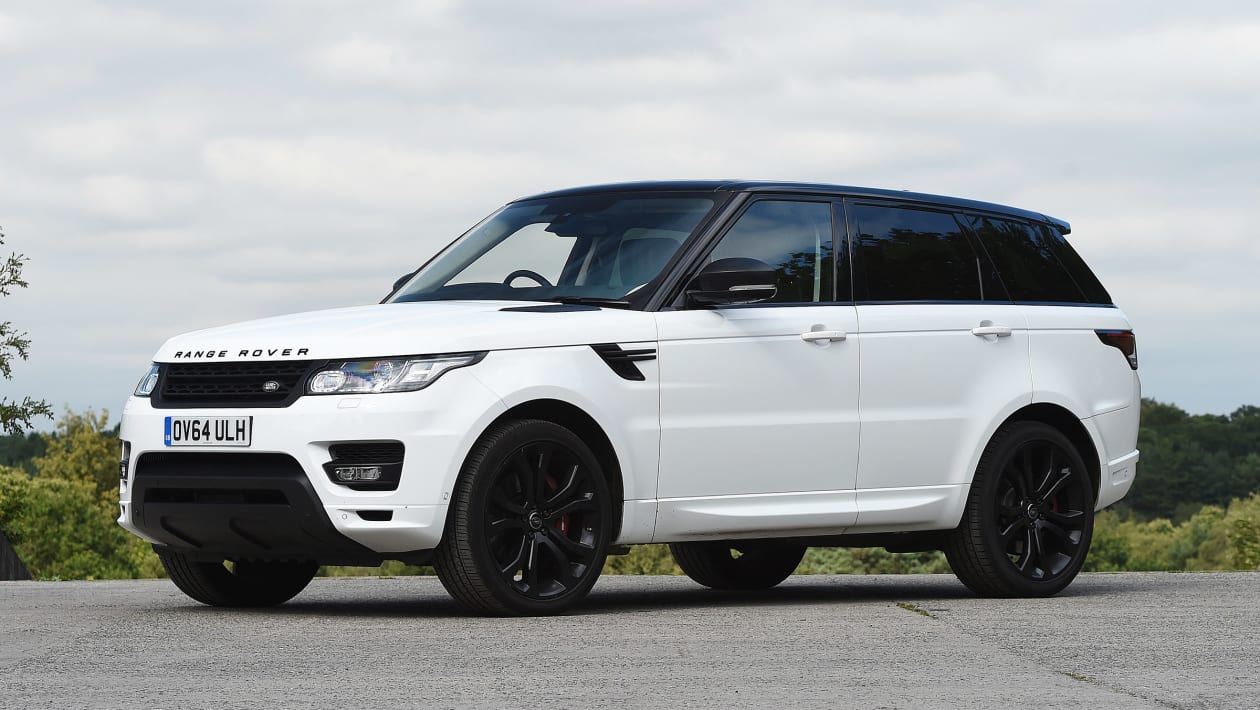
Verdict
Land Rover’s reputation for dependability has taken a bashing, thanks to the complexity of models such as the Range Rover Sport. Based on the same platform as the contemporary Range Rover, the Sport is a bit smaller and more agile, but it’s still a big car with the associated high running costs. Y
ou’ll pay plenty for fuel, road tax and maintenance, while insurance is also costly, because these cars are very popular with thieves, so decent security is another essential part of ownership. The Range Rover Sport gives plenty in return, with its off-roading, cruising and towing abilities, but which engine you go for will make a big difference to the driving and owning experience, so choose carefully.
Land Rover celebrates its 75th anniversary in 2023, and it’s fair to say that the brand has come a long way since 1948.
For many years its products were crudely engineered yet capable of going anywhere, but in the eighties there was a shift towards greater luxury (the original Range Rover was surprisingly utilitarian), and things have gathered pace since then.
The Mk1 Range Rover Sport from 2004 could climb mountains or cruise at high speed on a motorway, all in perfect luxury. The second take on the formula was even more impressive, but it was also far more complex, which had an impact on reliability. So should you buy a second-hand Range Rover Sport Mk2, or is the risk too great?
History
The second-generation Sport was launched in September 2013 with 258bhp TDV6 or 292bhp 3.0-litre SDV6 diesel engines, or a 510bhp 5.0-litre V8 petrol, each offered with an eight-speed automatic gearbox only. In November 2014 a 339bhp 4.4-litre SDV8 diesel joined the range, and in February 2015 the 542bhp supercharged 5.0 V8 Sport SVR and 335bhp SDV6 hybrid arrived.
Used — available now
2027 Land Rover
Range Rover Sport
42,669 milesAutomaticDiesel3.0L
Cash £67,634
View Range Rover Sport
2027 Land Rover
Range Rover Sport
28,854 milesAutomaticDiesel3.0L
Cash £59,500
View Range Rover Sport
2023 Land Rover
Range Rover Sport
44,892 milesAutomaticPetrol3.0L
Cash £56,100
View Range Rover Sport
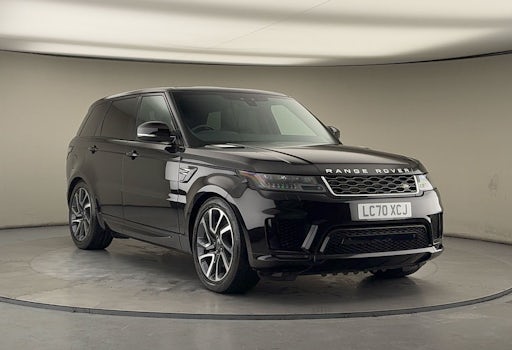
2022 Land Rover
Range Rover Sport
29,336 milesAutomaticPetrol3.0L
Cash £31,000
View Range Rover Sport
At the end of 2016, 2.0-litre diesel and supercharged 3.0-litre V6 petrol engines appeared, then a year later Land Rover’s first plug-in hybrid, the P400e, reached showrooms, with a 2.0-litre petrol engine.
This motor also came in 296bhp Si4 non-hybrid form, and at the same time the SVR was upgraded to 567bhp. The HST, launched in February 2019, came with a 395bhp 3.0-litre supercharged straight-six petrol engine, featuring mild-hybrid technology.
Which one should I buy?
For real-world purchase and running costs, we’d choose the SDV6 thanks to its blend of performance and economy (although fuel bills will still be high), while seven-seat cars improve usability. All Mk2 Range Rover Sports have leather trim, DAB radio, automatic headlights and wipers, a powered tailgate, climate control, heated front seats, navigation and air suspension.
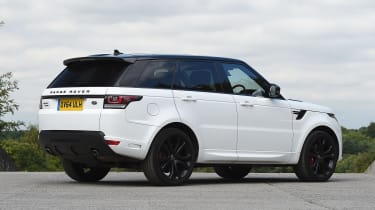
The HSE adds 20-inch wheels, 14-way electric front-seat adjustment with memory, heated rear seats, powered steering-column adjustment, paddle-shift controls, a heated windscreen and a rear-view camera. The HSE Dynamic has 21-inch alloys and a twin-speed transfer box, while the Autobiography Dynamic features High-Beam Assist, configurable interior mood lighting, a premium hi-fi, adaptive cruise control and extra driver-assistance systems.
Alternatives to the Range Rover Sport
There are some tempting rivals, not least the Sport’s bigger brother, the Range Rover, along with the Range Rover Velar, which come only in five-seat form. If seven seats are key, the Land Rover Discovery might suit, while the Volvo XC90 is stylish and comfortable, but the Swedish model only comes with four-cylinder engines.
Three German alternatives that give the Land Rover a hard time are the Audi Q7, BMW X5 and Mercedes GLE; all are costly to buy and run, but feature luxurious cabins packed with technology. That’s also true of the Porsche Cayenne, which comes with five seats only, just like the BMW X6, and Mercedes GLE Coupé and Porsche Cayenne Coupé. Two less obvious choices are the Maserati Levante and Volkswagen Touareg.
What to look for
ULEZ
The Sport wasn’t Euro 6-compliant until September 2015. Cars with an AdBlue tank will be exempt from any clean-air zones.
Tyres
The original Continental tyres had a layer of foam inside to reduce road noise. It works brilliantly, but it means that punctures can’t be repaired.
Panel fit
Poor panel alignment is common, while leaks aren’t unusual from the tailgate and sunroof; both of these can cause chaos with the electrics.
Towing
The SDV6, SDV8 and 5.0 V8 editions are all rated at up to 3,500kg. But the P400e can pull just 2,500kg, while the Si4/P300 and SVR are rated at 3,000kg.
Reliability
Owners’ forums show that the Range Rover Sport can suffer from a lot of problems, some of which are expensive
to fix. Many owners have enjoyed trouble-free motoring, though, so be scrupulous with your pre-purchase checks.
Interior
The cabin is one of the reasons why you’ll want a Range Rover Sport; it’s packed with premium materials, and is very comfortable and hi-tech, but the infotainment should be much better than it is.
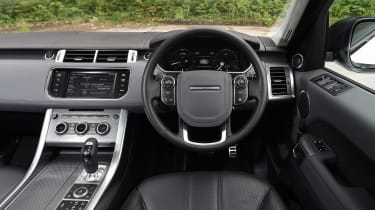
A third row of seats was an option (and fitted to just one car in 25) and these are cramped for adults, but rows one and two are spacious enough. Land Rover calls the seven-seat Range Rover Sport a 5+2. Also bear in mind that if you buy a seven-seater, there’s no room for a spare wheel.
In five-seat mode, the boot has a 784-litre capacity. It’s 1,761 litres with the backrests folded.
Prices
We found just over 3,000 Range Rover Sport Mk2s for sale, almost three-quarters of which were diesels, with 80 per cent fitted with the SDV6 unit. If performance is your thing, we found more than 400 SVRs on the market.
Running costs
All diesel and plug-in hybrid models must be serviced every 12 months or 16,000 miles; for petrol cars it’s two years or 21,000 miles. An oil and filter change costs £300, while new fuel and pollen filters push this towards £500.
Maintenance costs for diesel models are generally £500-£1400; the seventh service includes a new cambelt. For petrol models, every third service costs around £1,300, while the sixth service costs £1,200 for plug-in hybrids. Only the diesel engine has a cambelt, but these charges are just for fluids, belts and filters, with brakes, suspension and tyres additional.
The timing chain needs to be replaced every five years or 140,000 miles. An official dealer charges around £600, and replaces the water pump at the same time. Fresh brake fluid is needed every two years, at £70.
Recalls
The Range Rover Sport Mk2 has been recalled 22 times so far. The first action was issued within a month of the car going on sale, because of the wiring loom chafing. The most recent campaign was launched in August 2022, because of faulty seatbelt pre-tensioners.
In the intervening nine years there were a further 20 recalls, for problems as wide ranging as loose wheel nuts, the doors unlatching while on the move, airbag glitches and faulty seatbelts. Other potential issues include fuel leaks, brake servo failure, the autonomous emergency braking not working and the instrument cluster failing. Exhaust emissions could also be too high, the indicators could fail and the engine’s crankshaft pulley retaining bolt could fracture. Most of these recalls also affected other models within Land Rover’s range.
Driver Power owner satisfaction
The Range Rover Sport Mk2 only appeared in our Driver Power new-car survey in 2015, when it came 22nd out of 150 entries. The model did make an appearance in our 2022 Driver Power used-car survey, though, coming 72nd out of 75 entries. The high running costs and poor reliability (it came last for the latter) held the car back, but owners did like the Range Rover Sport’s looks and drivetrain.
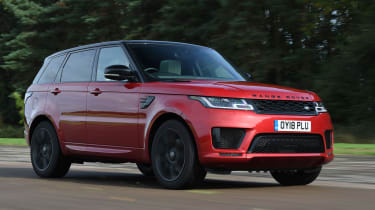
Range Rover Sport (2013-2022) review: What we said
Extracts from our 2022 Range Rover Sport road test…
We are big fans of the Range Rover Sport. It’s one of the most popular premium SUVs currently available, and deservedly so: the Sport is great to drive and fully lives up to its name with strong performance and size-defying handling prowess. The seriously potent SVR model, meanwhile, is a genuine sports car on stilts, but even the four- and six-cylinder versions have ample power.
The Sport is as luxurious as you’d expect a big car wearing the Range Rover badge to be, and although not cheap to buy, it’s an accomplished and impressive machine. There’s little to fault and a lot to like: with owners telling us they’re equally delighted, we’re happy to recommend it.
About the Range Rover Sport
The Range Rover Sport was first introduced in 2005 as a trendier, more accessible alternative to the full-sized Range Rover. This allowed the bigger model to move further upmarket, while the Sport competed with cars like the Porsche Cayenne and BMW X5.
The current model, launched in 2013, is the second generation of Range Rover Sport. While the original model was based on the same platform as the Land Rover Discovery, and was massively heavy as a result, this model is all-aluminium and significantly lighter. That pays dividends on and off-road, and the Sport is an amazingly capable vehicle wherever you take it, given its size.
Land Rover sells the Range Rover Sport in a single five-door bodystyle, with this generation introducing the option of a third-row of seats in the rear. That makes this the first seven-seat Range Rover, as not even its bigger brother seats more than five. The arrival of a three-row version was partly in response to customer demand.
The range includes a mix of four-, six- and eight-cylinder engines, with mild and plug-in hybrid tech features across the range to help improve economy and lower emissions. The 3.0-litre, six-cylinder D250, D300 and D350 diesel versions include a belt-driven starter generator and a 48v battery to help with overall efficiency, as does the 3.0-litre petrol P400 variant.
The P400e plug-in hybrid combines a 2.0-litre four-cylinder petrol unit with a 85kW electric motor, delivering a total of 398bhp. For those seeking extra performance, the P575 SVR with its supercharged V8 engine should provide enough shove with 567bhp.
There are six trim-levels to choose from: HSE, HSE Silver, HSE Dynamic, HSE Dynamic Black, along with HST and Autobiography Dynamic. The SVR is essentially a standalone version, although does include a Carbon Edition upgrade.
The Range Rover Sport takes on the X5, Cayenne, GLE and Q7, along with left-field offerings like the Maserati Levante.
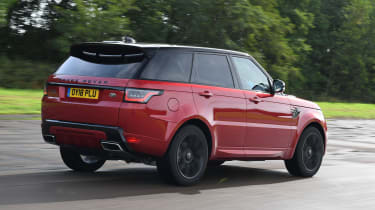
Engines, performance and drive
The second-generation Range Rover Sport really moved the game on in terms of drive and dynamics. The all-new, all-aluminium architecture is very stiff and robust, and the firm’s advanced suspension design and accomplished four-wheel drive system give a driving experience that is unlikely to disappoint.
The natural abilities of the Range Rover Sport are clear from the off. Although the steering is a bit light, it’s also extremely accurate and crisp, making it easy to drive this big machine both in town and on twisting B-roads. The balance is spot on, it never feels top-heavy or vague, and generally has control and composure that would amaze those who dismiss it as a big, heavy 4×4.
All Range Rover Sports come as standard with height-adjustable standard air-suspension and Land Rover Adaptive Dynamics. This system adjusts the suspension and electronic controls to suit the road conditions, and it includes a Dynamic mode that impressively minimises body roll and maximises grip. Sure, the ride becomes knobblier as a result, but it’s beautifully accomplished in regular mode, with peerless body control, ample absorbency and terrific stability. Dynamically, the Range Rover Sport is little short of superb.
Thanks to Land Rover’s peerless off-road pedigree, the Sport’s abilities outclass those of its rivals when you head off the beaten track. It has an electronic centre differential and Land Rover’s clever Terrain Response system, which optimises the car for mud, gravel, snow, rocks and sand by juggling suspension height, gearbox settings, throttle response and traction control profiles. Despite the car’s size and weight and luxury billing, the combination of rugged chassis components and clever electronics give this big SUV some impressive off-road credentials.
Even driving across rivers should hold no nasty surprises, thanks to an impressive 850mm wading depth – there’s even a gadget that shows you how deep the water that you’re driving through is.
HSE Dynamic models and above come with an enhanced Terrain Response 2 system – this includes automatic terrain sensing, which engages the correct mode when it senses a change in surface below: ingenious stuff. Also on Dynamic models is the JLR All-Terrain Response Control. This is a sort of ‘off-road cruise control’, letting the driver select a desired speed and leaving the car to do all the hard work. It can even set the vehicle moving from rest, which is ideal when grip is low or the terrain is rough or steep.
The SVR is, of course, another matter entirely. Decidedly performance-focused, it has massive wheels, big brakes, stiffened suspension and intricate development throughout to give it performance that makes it the SUV king of the Nurburgring. The simple fact that its top speed has been raised to 162mph should show the development that’s gone into this 2.5-tonne machine. It shouldn’t work, and shouldn’t deliver Jaguar-like engagement – which makes it all the more remarkable that it does.
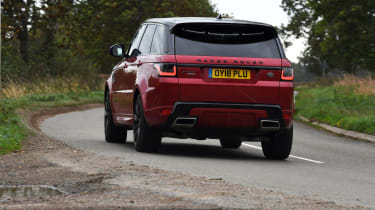
Engines, 0-60 acceleration and top speed
The P400 version uses a straight-six petrol engine that pushes out 395bhp with the help of a 48-volt mild-hybrid system. It’s an engine that imbues the Sport with smooth, potent performance, especially in its low and mid-range — with a 0-62mph time of 5.9 seconds and 140mph maximum speed. The same mild-hybrid tech is included on the D250, D300 and D350 diesel variants, with resulting sprint times of 8.5 seconds, 7.3 seconds and 6.9 seconds, respectively.
As part of the 2018 model year update, Land Rover unveiled a plug-in hybrid version, Jaguar Land Rover’s first PHEV. Wearing the P400e badge, the Range Rover Sport combines a 296bhp turbocharged 2.0-litre petrol engine with an 85kW electric motor to provide a total output of 398bhp and 640Nm of torque.
It has the claimed ability to travel up to 25 miles on pure electric drive – although this will depend significantly on how careful you are with your right foot – with a top speed of 85mph. It will also give the 5.0-litre V8 a run for its money in pure performance terms, sprinting to 62mph from rest in 6.3 seconds, before reaching a top speed of 137mph.
Around town, it’s at its best, with the electric motor giving quick and quiet acceleration. However, when you have to rely on the four-cylinder engine, it reveals some shortcomings. The extra weight of the plug-in system means the engine has to work harder than it would otherwise when it isn’t getting an EV boost – and it’s not the most refined unit. So, if you floor the throttle and ask for maximum power from both power sources, then the whine of the engine is slightly at odds with the sporting luxury of the car.
https://www.autoexpress.co.uk/land-rover/range-rover-sport/104774/used-range-rover-sport-mk2-2013-2022-review-and-buyers-guide